Ireland
 UK
UK Scotland
 London

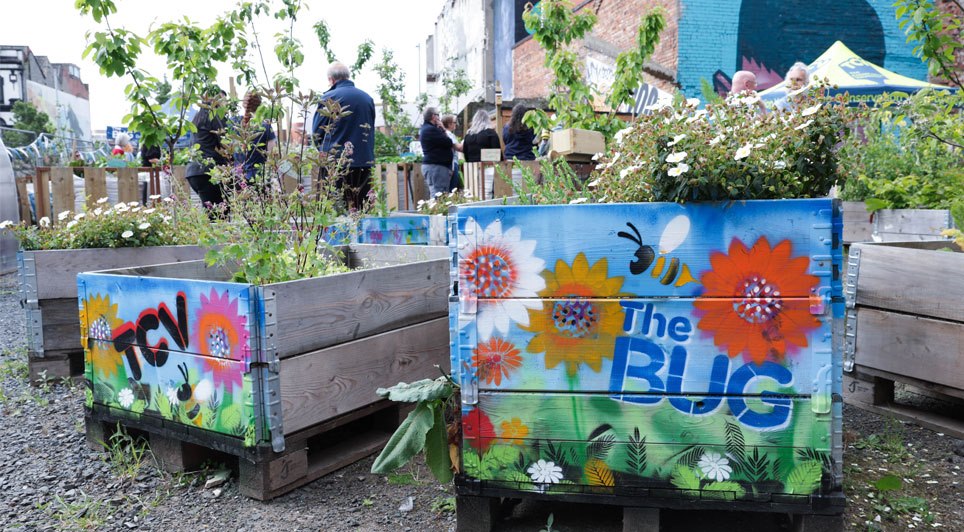
An evaluation of The BUG (Belfast's Urban Garden), completed in partnership with Belfast Healthy Cities, has underlined the case for investing in urban growing projects.
Run by Belfast City Council and The Conservation Volunteers as a 'Demonstrator' project from spring 2024 to summer 2025, and financed by the Department for Infrastructure's Blue~Green Infrastructure fund alongside the Public Health Agency, the scheme tested how a temporarily vacant, or "meanwhile", city-centre plot could be reimagined as a social garden and provide lessons for future greening.
Across its lifespan, the site welcomed almost 3,000 visitors, created hundreds of volunteering opportunities and offered support to some of Belfast's most vulnerable individuals and groups.
Identified by Belfast Healthy Cities' Greening the City Advisory Group through its 'Grey to Green' programme, The BUG responded to a recognised shortage of green space in the city centre and supported the ambition in A Bolder Vision for Belfast to make the core greener, more attractive and more people-friendly.
Councillor Joe Duffy, Chair of Belfast City Council's City Growth and Regeneration Committee, said: "Our ambition was for a city-centre project that could combine urban growing, community engagement, and education and learning, linked to health and wellbeing and transforming our land on a temporary basis at the Belfast Stories site on Kent Street.
"The BUG far exceeded our expectations as a 'proof of concept' for city centre greening. The BUG proved to be a powerful social connector across ages and backgrounds – and particularly with those at the greatest risk of health inequalities. It offered an inclusive, safe shared space where, regardless of social or cultural differences, friendships grew alongside the fruit and veg.

"Along with The Conservation Volunteers, Belfast Healthy Cities and the Public Health Agency, we've shown how a city centre development site can be successfully used for community benefit in the interim – and hope that we can share our learnings to inspire our city partners to open up further opportunities."
Jacqueline O'Hagan, Healthy City Coordinator at Belfast Healthy Cities, added: "The Belfast Urban Garden demonstrated in a really practical way how reimagining underused urban spaces can deliver tangible benefits for health and wellbeing. Through our Greening the City Advisory Group, we have long advocated for integrating nature-based solutions into urban planning, particularly in areas where access to green space is limited.
"The BUG showed that even temporary interventions can reduce isolation, build on a sense of community, and support mental and physical health. Importantly, it highlighted how greening initiatives can contribute to tackling health inequalities by creating inclusive spaces where everyone feels very welcome. We hope the learning from this project will inform future regeneration and city centre planning, ensuring that health equity and access to nature remain central to Belfast's development."
Participants described the garden as an "oasis" within a grey, concrete setting – a warm, welcoming and interactive place that, unlike a traditional park, encouraged people to "do" things, meet others and take part in positive activity.
Those attending Saturday Green Gym sessions said they were proud to see a meanwhile plot used for nature-based activity rather than lying derelict or becoming a car park. Alongside growing food, herbs and flowers, people learned about biodiversity, shared produce and helped build practical infrastructure, including a polytunnel. The focus group consistently reported mental health gains, with one participant noting: "Even if I was having the worst day, I always left The BUG feeling like a weight had been lifted."
Siobhan Donald, Assistant Director of Strategic Public Health at the Public Health Agency, said: "The Belfast Urban Garden project has shown how the use of a temporary green space can have a lasting impact on people and communities. By engaging almost 3,000 visitors, creating hundreds of volunteering opportunities and supporting some of the most vulnerable individuals and groups in our communities, the project has helped improve wellbeing, reduce social isolation and strengthen community connections, while demonstrating the potential of urban gardening and food growing projects in the heart of a city setting."
With the project now complete, The Conservation Volunteers are reusing materials from the site and are keen to develop further opportunities for city-centre greening.