Ireland
 UK
 Scotland
 London


The Labour party have claimed the revelation that almost 120,000 houses stand empty in Ireland is akin to an Irish "Domesday Book".
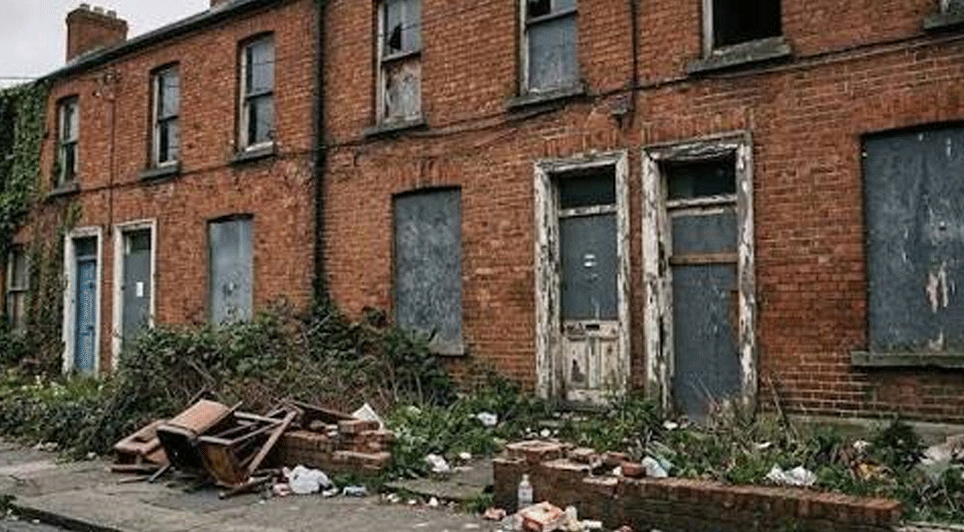
A report from the Department of the Environment, published yesterday, said there are more than 2,800 so-called ghost estates in the country, leading to calls for action by the Opposition parties.
The report, giving a county-by-county inventory of unfinished estates, identified some 23,000 completed but unoccupied houses and apartments commissioned by the Department of the Environment.
A further 20,000 are at various stages of completion, half of which have been identified as being at "early stages" of construction. Just over 78,000 houses within incomplete estates are occupied, while 58,000 houses have permission but have not been built.

is clear is that people who bought homes in these estates are living through a hell that has come about as a result of a government that saw housing policy simply as a means of delivering bounty to their pals in the construction and investment community, rather than providing homes for people who need a place to live.
Labour Spokesman on Housing, Ciarán Lynch, said it is clear that people who bought homes in the estates are "living through a hell" as a result of the Government's housing policy.
Mr Lynch said many of the estates were given the go ahead as a means of delivering "bounty to their pals in the construction and investment community", rather than providing homes for people who need a place to live.
"[The report] reads like a Domesday Book for the tail end of the Celtic Tiger. We need a plan of action to tackle this scourge, as a matter of urgency. These estates are at best an eye-sore and at worst a safety and security risk for local residents. In particular we need action on issues like security on incomplete estates, establishing teams at local level to tackle this problem."
The survey was carried out by the department from May to September. It shows that building had started on 120,000 homes in ghost estates.
An expert group is now being set up by the Government to advise on how best to deal with the problems of ghost estates. Membership of that group will include representatives of local authorities, the banking and construction sectors, NAMA and building professionals.
(DW)