Ireland
 UK
UK Scotland
 London

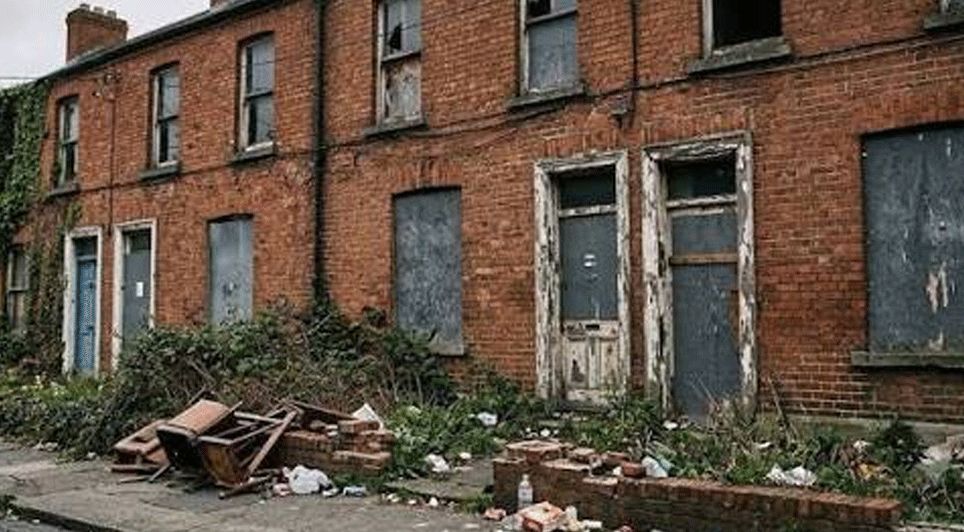
Cork should get aid to redevelop so-called 'ghost estates' providing work for the beleaguered construction sector and allowing those in housing need to be accommodated.
The Dáil Minister for the Environment John Gormley has been urged to introduce a State-wide policy to assist local authorities to call in bonds pledged by developers to allow the completion of 'ghost estates'.
The Mayor of Cork County, Cllr Jim Daly said almost €60 million was being held in bonds by Cork County Council alone and he has estimated the figure nationally to be €500 million to €600 million.
Speaking to the Irish Times, Mr Daly said Cork County Council usually accounted for 10% of planning applications, and this was supported by the fact that the council has 284 ghost estates, while the country had 2,800 unfinished estates.

He said planning permission for any development involving public infrastructure such as roads, paths and lighting was only issued with a condition that the builder sign a bond in the event of being unable to finish the public areas.
These bonds are obtained by builders from banks and insurance companies at a rate of about half the variable lending rate, ie currently approximately 2%.
The bond can be called in by a local authority if a builder fails to complete the public areas of a development satisfactorily, and can be used to ensure that paths, roads and lighting are finished to a satisfactory standard.
Mr Daly said although the money was not actually borrowed by the developer, the bank does charge the developer for it as it was available to the developer much like an overdraft facility.
He said that many of the bonds lodged to cover the costs in ghost estates during the construction boom years would now cover more than the cost of the work involved as construction costs had dropped by an estimated 40%.
He claimed developing a co-ordinated policy nationally to assist local authorities to call in the €500 million to €600 million tied up in such bonds would be a huge boost to the construction industry, which has suffered greatly in the recession.
And given that an estimated 70 per cent of money spent in the construction sector reverted to the State through both direct and indirect taxes, it would also benefit the exchequer while helping stimulate jobs in construction.
(BMcC/KMcA)