Ireland
 UK
UK Scotland
 London

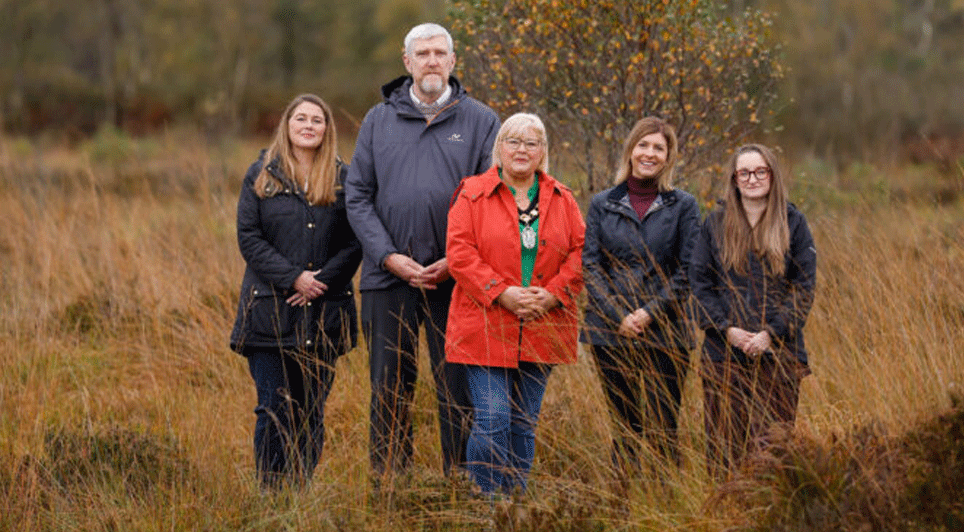
A project to restore a large bog area in Ballymena is continuing to make significant progress.
The Garron Plateau Peatland Restoration Project at Dungonnell Reservoir includes the restoration of 493 hectares of globally rare blanket bog. More than 1000 dams have been installed to block bog drains, allowing peat revegetation and rewetting.
The Royal Society for the Protection of Birds, Northern Ireland (RSPB NI) is delivering the key project in partnership with NI Water.
Infrastructure Minister Nichola Mallon visited the site of the project to see first hand the important work that is being done.
Speaking during her visit, Minister Mallon said: "Visiting the Garron Plateau Peatland Restoration Project today at Dungonnell reservoir, home to the largest blanket bog in the North, has given me a real insight into the importance of this restoration project.
"Delivered under budget and ahead of schedule, this has restored the natural functions and conditions of the bog which in turn has reduced greenhouse gases, prevented peat erosion and provided habitat improvement for priority and protected species such as marsh saxifrage, hen harriers and curlews. It has also improved the quality of water entering the water treatment works and, as a consequence, cut costs in the production of clean, safe drinking water for almost 12,000 homes and businesses in the area.
"I also had the opportunity to discuss planning issues around peatlands with RSPB NI and to listen to their views on how my Department and the planning system can be supportive. I believe that the planning system has an important role to play and I have asked my officials to continue to proactively engage with stakeholders to ensure that planning can play a positive role."
Roy Taylor, Catchment Manager for NI Water commented: "The Integrated catchment approach is now widely regarded as a viable alternative to costly 'bricks and mortar' capital projects and has been widely adopted by water companies across the UK. In many cases it has proved to be more sustainable and more cost effective than dealing with water quality issues at the treatment works. This was the first project of this type undertaken by NI Water and the success so far is as a result of excellent cooperation between a number of agencies along with NI Water, through the Sustainable Catchment Area Management Planning (SCaMP) programme. Removing pollutants at water treatment works involves using costly chemicals and our aim is to help improve land management so that water quality and quantity is improved at source, long before it reaches our works. It also goes a long way to reducing our carbon footprint and reaching our net zero carbon targets by 2050."
Joanne Sherwood, Director RSPB NI, added: "We've seen the benefits that peatland restoration can bring for climate, nature, and people and we were delighted to showcase our partnership work on the Garron Plateau to the Minister today. A recent study commissioned by RSPB NI showed that for every £1 spent on restoring peatland, there is £3.91 returned in benefits to biodiversity and carbon sequestration, as well water flow and quality, and flood prevention.
"We would like to see vital work on nature-based solutions like this scaled up to address the nature and climate emergency, as well as to support local communities and economies. This will all help to tackle climate change.
So we are pleased the Minister listened to our views about how the planning system can play its part more effectively to restore and protect peatland."