Ireland
 UK
UK Scotland
 London

The Government has approved a new landmark Bill that will see the introduction of 'world-leading moves to reduce waste and influence behaviour'.
The new Circular Economy Bill will underpin Ireland's shift from a "take-make-waste" linear model to a more sustainable pattern of production and consumption that will instead minimise waste to help significantly reduce our greenhouse gas emissions.
In a circular economy, waste and resource use are minimised. The use and value of products and materials is maintained for as long as possible. When a product has reached the end of its life its parts are used again and again – to create further useful products, instead of being discarded which is an all too familiar pattern now.
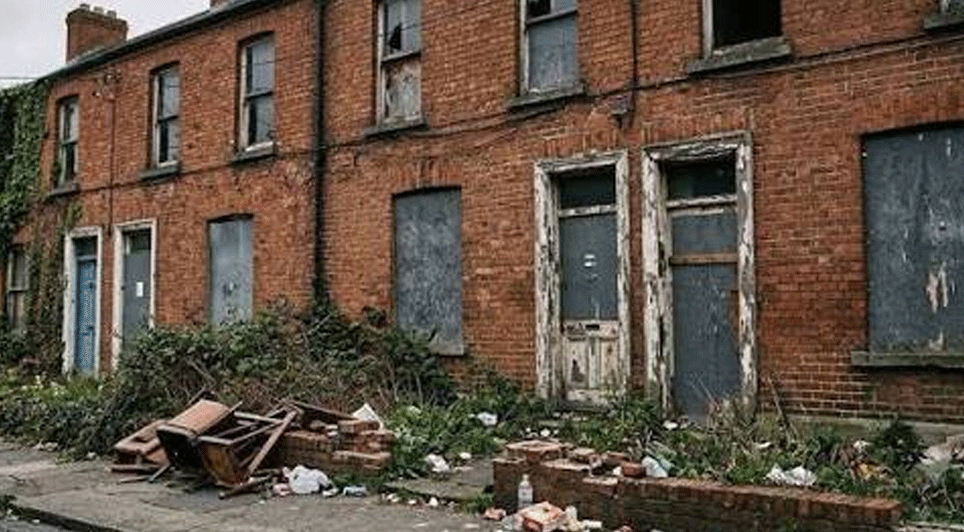
A significant action provided for, under the proposed new legislation, will see Local Authorities empowered to use GDPR-compliant technologies such as CCTV to detect and prevent unsightly and illegal dumping and littering, among other measures. This will help to discourage "fly-tipping" which is a blight across the country.
With this Bill, over time, a range of single-use disposable products will also be phased out. Among its targets is to make Ireland the first country in the world to eliminate the use of disposable coffee cups, nearly half a million of which are currently sent to landfill or incineration every day, amounting to 200 million cups a year.
This process will begin with a ban over the coming months on the use of disposable coffee cups for sit-in customers in cafés and restaurants, followed by the introduction of a small charge on disposable cups for takeaway coffees that can be avoided completely by using a keep cup. This will operate in the same way as the existing Plastic Bag Levy, which has been so successful in reducing plastic bag litter across the country.
Minister of State with responsibility for Communications and Circular Economy, Ossian Smyth TD, said: "This bill aims to stop the wasteful pattern of using valuable resources once and then just binning them. From discouraging the use of single-use items, to improving the process for allowing recycled materials onto the market, this legislation will support the development of sustainable products and business models across the economy."
He added that Ireland had led the way 20 years ago with measures that dramatically curbed the use of plastic bags and the associated litter that they caused.
The Bill builds on the Government's commitment to achieving a circular economy, as set out in the 2020 Waste Action Plan for a Circular Economy and the 2021 Whole of Government Circular Economy Strategy. This Bill now places that strategy on a statutory footing, putting the re-use of resources and reduced consumption at the heart of the Irish economy.
The Bill also effectively calls time on coal exploration by ending the issuing of new licences for the exploration and mining of coal, lignite and oil shale. This follows-on from Programme for Government commitments to end new licences for the exploration and extraction of gas, which was in line with the previous 2019 decision to end oil exploration and extraction.
Minister for the Environment, Climate and Communications, Eamon Ryan TD, said: "The publication of this Bill is a landmark moment in this Government's commitment to making the circular economy a reality in Ireland. Through a mix of economic incentives and smarter regulation we can achieve far more sustainable patterns of production and consumption that move us away from the patterns of single-use and throw-away materials and goods that are such a wasteful part of our economic model now. We have to re-think the way we interact with the goods and materials we use every day, if we are to reach net-zero greenhouse gas emissions, because 45% of those emissions come from producing those goods and materials."