Ireland
 UK
UK Scotland
 London

Sisk has been appointed to construct a new £25 million extension building as part of the Diamond-II upgrade for Diamond Light Source (Diamond), the UK's national synchrotron.
Work has started on the Diamond, located at the Harwell Science campus in Oxfordshire. This science facility will receive a £519 million investment from the UK Government and the Wellcome Trust, with contributions of 86 per cent and 14 per cent respectively, for upgrades and expansion.
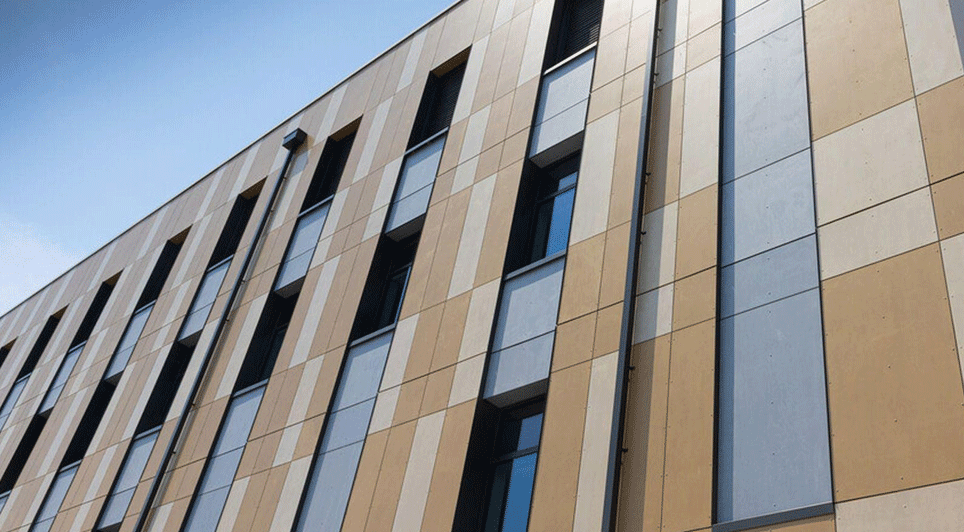
Sisk will complete the Diamond Extension Building (DEB) which will be located to the southeast of the existing Diamond Synchrotron building at the Harwell Science campus. The building consists of two adjoined parts. DEB1 will include assembling facilities for 52 new Girders on the ground floor and offices and labs on the first floor. DEB2 will be used to store both the incoming 'bare' Girders, and the fully assembled Girders, and will provide valuable space for Diamond’s future development after the completion of Diamond-II.
The Diamond-II upgrade will deliver a new, highly advanced machine along with extra beamlines, including a wide range of improvements to optics, detectors, laboratories and beyond. Anticipated benefits include providing real-time insights for advanced manufacturing, improving next-generation batteries and expediting drug development.

Donal McCarthy, COO, Data, Life Sciences & Tech, Sisk stated: "We are delighted to confirm our second Sisk project at Harwell Science campus. Diamond Light Source is a true science and technology project and a rare fabrication facility assembly. We believe that we have the skillset and experience to deliver this highly technical facility. Sisk looks forward to working with Diamond and our local supply chain partners to delivering an innovative world class science and research facility."
Dr Richard Walker, Interim Project Director for Diamond-II, Diamond Light Source said: "I am very pleased that after receiving the approval from the UK Government, together with Wellcome, we are now starting construction of one of the key elements in our delivery of Diamond-II. Given that many other similar facilities around the world are carrying out similar upgrades, without the Diamond-II upgrade we would eventually become uncompetitive and enter a rapid decline, to the detriment of UK science and innovation so this investment in buildings is the major first step to set us on track to successfully deliver the upgrade to the facility."
Diamond harnesses the power of electrons to produce bright light that scientists can use to study anything from fossils to jet engines to viruses and vaccines. The machine accelerates electrons to near light speeds so that they give off light 10 billion times brighter than the sun. These bright beams are then directed off into laboratories known as 'beamlines'. Here, scientists use the light to study a vast range of subject matter, from new medicines and treatments for disease to innovative engineering and cutting-edge technology.
This is the second project at the Harwell Science campus, Oxfordshire that Sisk has won having recently been announced as fit-out contractor for Moderna, a biotechnology company pioneering messenger RNA (mRNA) therapeutics and vaccines.