Ireland
 UK
UK Scotland
 London

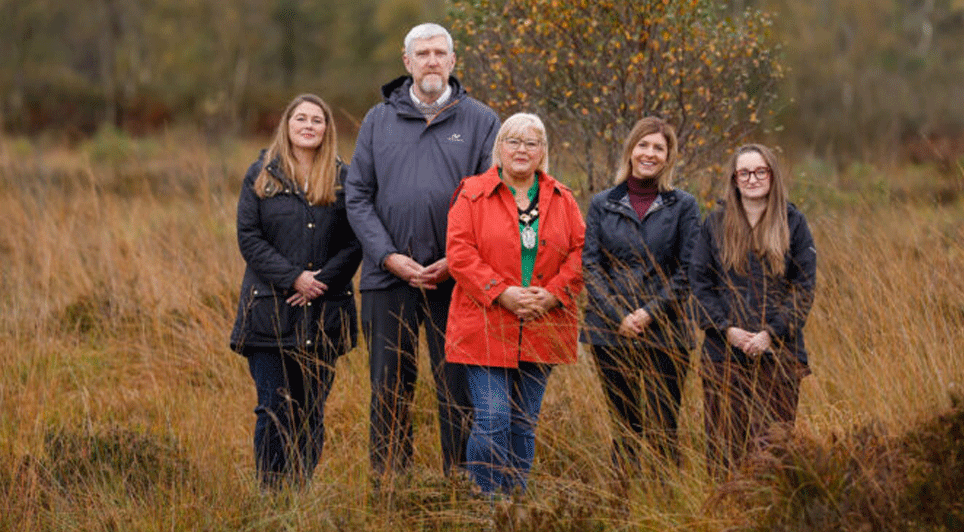
Representatives from the Ireland-based Dúlra project recently visited the National Trust for Scotland to exchange knowledge and best practices in peatland and woodland conservation.
The Dúlra project, operating in Mayo and Connemara, focuses on restoring and protecting Irish peat bogs and temperate rainforests from the invasive rhododendron plant. The project employs around 20 field operatives to control the spread of this invasive species across three Special Areas of Conservation.
The National Trust for Scotland, facing similar challenges with rhododendron encroachment in its own properties, welcomed the opportunity to share its expertise with the Dúlra team.
A key highlight of the visit was a demonstration of the Trust's innovative approach to rhododendron removal in Torridon. Rob Dewar, Invasive Species Project Officer at the Trust, showcased the successful implementation of "stem treatment" techniques and outlined the Trust's collaborative efforts with the Alliance for Scotland's Rainforest.
This knowledge exchange underscores the importance of cross-border collaboration in addressing shared environmental challenges and promoting best practices in conservation.
Rob Dewar said: "Working with Alliance for Scotland's Rainforest (ASR) has been a very satisfying experience as there is a wealth of knowledge within the partnership that we all share. Rhododendron ponticum is one of the major threats to Scotland's rainforest, and the ASR has been able to raise awareness of the problem. The Trust has been so successful in the control work of this invasive plant, and has made some valuable contributions. One of these is a beautiful short film of control work within the rainforest, which can be found on the ASR website."
The Trust is also part of the Glen Torridon Partnership Project that aims to enhance and protect native habitat in the glen, expand areas of Scottish rainforest, and control the threat of Rhododendron ponticum.
The Dúlra team then met Kevin Ball (Head Gardener at Inverewe Garden), who explained how the invasive rhododendrons in the garden shelterbelt had been harvested to produce biochar, using a retort kiln that burns at extremely high temperatures.
The biochar is then mixed into the compost and applied back into the garden to both improve the soil and lock in carbon. This whole process, including its interpretation, was selected for the initial shortlist for the RSPB 2024 Nature of Scotland Awards in the 'innovation' category.
The kiln also featured on a recent visit to Torridon from the Inverness Feminist Bird Club. Rory Shannon (ranger at Torridon Estate) and Jess Carnegie (Community Engagement Officer) provided a tour and guided demonstration. The group then explored Rhododendron ponticum management on the estate, learning about the kiln and its benefits for the Trust. The kiln is now on loan to the Woodland Trust Scotland, which will be producing its own biochar as part of rhododendron control at the recently acquired Couldoran property near Ben Shieldaig.
Rainforest conservation is a priority in the National Trust for Scotland's vision to care for, protect and share Scotland's nature, beauty and heritage for everyone, as outlined in our 10-year strategy, launched in 2022.