Ireland
 UK
UK Scotland
 London

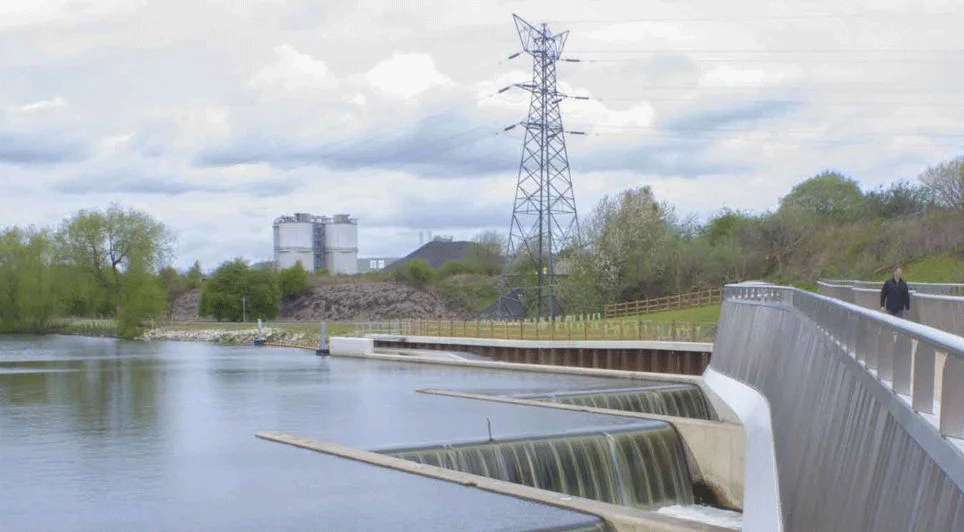
The Department of Housing, Local Government and Heritage has approved €13.6 million for 103 projects aimed at restoring free‑flowing rivers by tackling physical obstacles such as dams, weirs and culverts.
Led by Inland Fisheries Ireland (IFI) under the Barrier Mitigation Programme, the works are designed to improve river connectivity, bolster fish migration and enhance aquatic biodiversity.
The investment follows a commitment in the Government's 2024 Water Action Plan. IFI issued a funding call in May 2025 to identify and prioritise schemes that met ecological and delivery criteria. The approved projects will move through planning and construction phases over the next one to five years.
James Browne, Minister for Housing, Local Government and Heritage, said: "The 103 fish barrier mitigation projects being initiated across Ireland are an important step towards accelerating improvements in water quality, particularly with respect to river connectivity and fish migration. This lays a great foundation from which future success can be achieved to improve water quality. My Department is proud to continue to fund the National Barrier Mitigation Programme through the Government's current investment in water quality initiatives in 2026."
IFI began compiling a national inventory of longitudinal barriers in 2018, assessing and ranking structures for mitigation in recognition of their impacts on river flow and species. The Barrier Mitigation Programme was formally established in 2024, and today's announcement marks a further milestone in safeguarding river health.
Christopher O'Sullivan, Minister of State for Nature, Heritage and Biodiversity, said: "Today's announcement is an investment in the health of our rivers and the species that call them home, and a vital contribution towards the achievement of Ireland's targets for free-flowing rivers under the Nature Restoration Law. It's essential that we continue to make efforts to improve the ecological status of our freshwater habitats, not only to improve the fortunes of iconic and threatened species like Atlantic salmon, European eel and lamprey, but also for everyone who loves and cherishes their local river."
The programme supports obligations under the Water Framework Directive, conservation objectives in Special Areas of Conservation, and measures for Annex II and V fish species under the Habitats Directive. It will also contribute to climate mitigation, the EU Biodiversity Strategy target to restore at least 25,000 km of free‑flowing rivers by 2030, and Article 9 of the EU Nature Restoration Law on river connectivity and floodplain function.
Barry Fox, Deputy CEO of Inland Fisheries Ireland, said: "IFI is deeply committed to restoring natural connectivity in our rivers by removing obstacles for migrating fish. The agency is delivering an ambitious programme of barrier mitigation works nationwide. These works will contribute to the long-term sustainability and productivity of our rivers into the future."
Projects are distributed nationwide, including in Carlow (Milford Weir and St Mullin's sites), Cork (Clondulane and Glashaboy weirs, Doneraile), Donegal (Eske and Owenea weirs), Dublin (removal of barriers at seven weirs on the River Liffey and works on the Matt/Bracken River), Galway (Derryclare, Dawros and Barna streams), Kerry (Listowel Weir and Galey Bridge apron), Kildare (Cushaling and Figile sites), Kilkenny (Duiske River culvert and Tinnapark River), Laois (Barkmills Weir), Leitrim (Rossinver and Manorhamilton weirs), Limerick (Blackboy Weir), Louth (Drumcar and Tallanstown weirs), Mayo (Tawnyard Weir and Erriff culvert), Monaghan (Emyvale Weir), Offaly (Birr Camcor and Esker sites), Sligo (Montiagh Weir), Tipperary (Shanrahan Weir), Waterford (Mahon River), Wexford (Bunclody Weir and Pollmounty sluice) and Wicklow (Glen of Imaal Weir and multiple bridge aprons). A full list of approved sites has been provided by the department.