Ireland
 UK
UK Scotland
 London

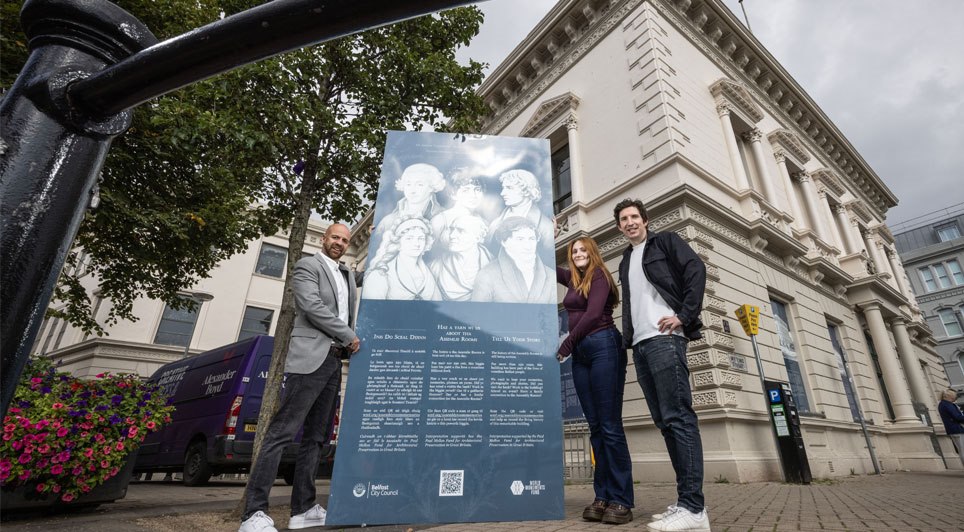
A new outdoor interpretation scheme comprising 29 trilingual panels has been unveiled on the exterior of Belfast's historic Assembly Rooms, highlighting the site's architectural and social heritage as part of broader city centre revitalisation plans.
Belfast City Council collaborated with the World Monuments Fund (WMF) to establish a conservation framework led by James Grieve Architects. The plan underpins both the conservation management of the 250-year-old landmark and the newly installed display panels, which feature text in English, Irish, and Ulster Scots.
The project forms part of a series of major development initiatives taking shape across Belfast city centre over the coming years:
• Assembly Rooms Re-use: Plans to conserve, restore, and repurpose the building to serve as a catalyst for urban regeneration.
• Belfast Stories Hub: A major new visitor attraction, public space, and creative hub scheduled to open on Royal Avenue in 2030.
• Cathedral Gardens Transformation: Works scheduled by next year to convert the space adjacent to Ulster University into a world-class public park.
• £280m Mixed-Use Delivery: A long-term strategic partnership with contractor GRAHAM to construct £280 million worth of residential-led, mixed-use schemes across the city centre.
Councillor Joe Duffy, Chair of Belfast City Council's City Growth and Regeneration Committee, said: "It's fantastic to see the history of the Assembly Rooms being shared with Belfast residents and visitors alike through this interpretation project – and I'd encourage anyone with memories of this wonderful building to get in touch to share them.

"We're very grateful for the World Monuments Fund's support which has allowed us to draw on James Grieve's expertise and knowledge to raise awareness of this iconic building's past and to give us guidance on the building's conservation. These beautiful panels show why the Assembly Rooms is one of Belfast's most historic and culturally significant assets, and we want to conserve, reinvigorate and reuse it in a way that will not only benefit our citizens, but act as a catalyst for further city centre regeneration.
"In the next few years, we're going to see this part of the city centre transformed. As well as bringing the Assembly Rooms back to life and giving it purpose and relevance for generations to come, we'll be opening Belfast Stories, a stunning new public space, visitor attraction and creative hub on Royal Avenue in 2030. By next year, we'll have transformed Cathedral Gardens beside Ulster University into a world-class public space for people to gather, relax and play, and in the coming years, our partnership with GRAHAM is set to deliver £280m worth of residential-led, mixed use developments, providing much needed city centre living."
The 29 interpretation panels chart the building's progression from an 18th-century market hall to a Georgian social hub and the subsequent headquarters of the Belfast Banking Company until its closure in 2000. Formulated with James Grieve Architects and the Royal Society of Ulster Architects (RSUA), the content spotlights three key architects alongside prominent figures such as Dr James McDonnell (1763–1845) and Martha McTier (1742–1837).
Recent remedial maintenance on the building's facade revealed historical elements, including a hand-painted "ghost sign" from past operations and a traditional after-hours banking night safe.
James Grieve said, "The research has revealed just how many layers of Belfast's history are contained within the Assembly Rooms. It has been especially rewarding to see those stories brought together and shared publicly, helping people understand how this remarkable building has evolved over more than 250 years."
Magnus von Wistinghausen, Executive Director at WMF Britain, explains: "These discoveries are a reminder that, even after more than 250 years, there is still more to learn about the Assembly Rooms. The conservation management planning process is not only about protecting the historic fabric, but also about ensuring that people can understand and connect with the places around them. Research into the Assembly Rooms provided the foundation for this engaging interpretative scheme. We encourage people in Belfast and beyond to learn more about this remarkable historic building and contribute their own memories, helping to ensure its significance is carried forward for future generations."
To support ongoing conservation efforts, WMF is asking the public to contribute photographs, personal stories, and memories connected to the site via their dedicated web portal: www.wmf.org/assemblyroomsmemories