Ireland
 UK
UK Scotland
 London

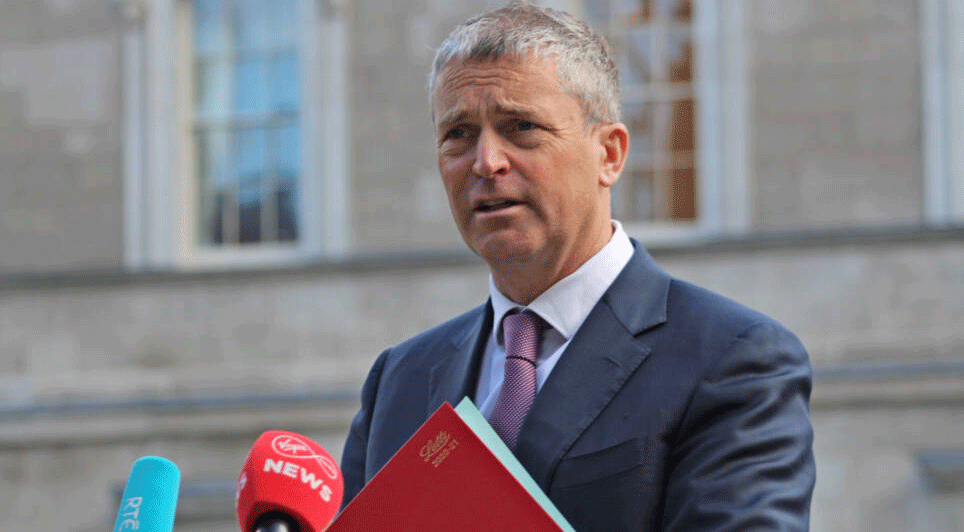
Sinn Féin’s spokesperson on Climate, the Environment and Energy, Pa Daly TD, has criticised the Government's newest energy package, saying it does not tackle the drivers of high bills.
He called for the rapid reinstatement of energy credits to deliver urgent support to families.
Daly argued the credits would create breathing space for structural changes, such as a windfall levy on excess energy profits, practical and affordable schemes to help households move away from fossil fuels, market reform to ensure data centres pay more towards grid costs, and accelerated deployment of renewables to secure permanently lower prices.
Teachta Daly said: "The Government's latest package of energy measures is being dressed up as a solution to Ireland's energy crisis. In reality, it fails to address the root causes of sky-high energy bills and will do little for the workers and families struggling right now to keep the lights on and heat their homes.
"The first and most obvious problem is that these measures do not provide the immediate relief households urgently need. Irish households continue to pay the highest electricity prices in the European Union, with prices almost 40% above the EU average according to Eurostat. At the same time, record numbers of households across the State are falling behind on their bills, with about half a million gas and electricity accounts in arrears.
"When families are already at breaking point, announcing grants that may or may not help them years down the line is no substitute for tackling the rip-off prices being charged today.
"Secondly, these measures expose the fundamental flaw at the heart of the Government's approach to transitioning households away from fossil fuels. Ministers point to grants of up to €14,500 for heat pump installations and new supports for batteries and solar panels as evidence of progress. But they continue to ignore the reality facing ordinary households. The cost of a deep retrofit and heat pump installation can run to €60,000 or €70,000 for many homes. A grant is of little use if you cannot afford the tens of thousands of euro that must still be paid up front.
"The result is a growing green divide. Time and again, uptake of Government schemes is concentrated among wealthier households and more affluent urban areas. Meanwhile, low and middle-income families, people living in older homes, and many rural communities are being left behind. At a time when the cost of living continues to rise, doubling down on schemes that remain inaccessible to much of the population is not a serious answer.

"It is particularly difficult to understand why the Government continues to lock some households out altogether. Solar remains unavailable under the Warmer Homes Scheme, while many social housing tenants are excluded from accessing the same opportunities being marketed to better-off homeowners. If solar power is such a good investment for reducing bills, why are those who would benefit most being left behind?
"The bigger problem, however, is that the Government continues to refuse to confront the structural failures within Ireland’s energy market. For years, Sinn Féin has argued that energy should be treated as a public good rather than a commodity for private profit. Instead of taking on powerful vested interests, successive governments have allowed ordinary households to shoulder the burden.
"Sinn Féin has repeatedly called for a robust windfall tax on excessive energy profits, stronger powers for the regulator to tackle price gouging, and a clear legal obligation on the regulator to put consumers first. Those proposals have been rejected time and again.
"The Government has also consistently given data centres a free pass while households pick up the bill. Research highlighted by my colleague Lynn Boylan has shown how Irish households are paying disproportionately towards network and grid costs, while data centres – which drive much of the need for expensive grid upgrades – contribute far less than they should.
"The regulator's current approach effectively socialises the costs and privatises the benefits. That is neither fair nor sustainable.
"This is why I will shortly introduce legislation to address this by mandating the regulator to prioritise consumer protection over big tech. This will complement the other bills I have introduced which strengthen the power of the regulator to hold energy companies to account and tackle price gouging as well as the introduction of a prioritisation framework for grid connections so that housing and critical infrastructure is prioritised over data centres.
"For that reason, I will shortly be introducing legislation to ensure that data centres pay their fair share of the costs they impose on Ireland’s electricity grid. Workers and families should not be expected to subsidise the profits of some of the largest corporations in the world.
"Finally, the Government continues to squander Ireland’s extraordinary renewable energy potential. The most effective way to reduce bills over the long term is to rapidly replace imported fossil fuels with abundant domestic renewable energy. Yet on offshore wind, one of Ireland’s greatest national assets, progress has been painfully slow.
"Ireland possesses an estimated 640GW of offshore wind potential, enough to transform our energy system and make the country a renewable energy powerhouse. Yet the Minister has now effectively admitted that no offshore wind project will be delivered by 2030. That is a staggering failure of ambition and delivery.
"After years of promises, the reality is that households remain trapped with some of the highest energy prices in Europe, record levels of arrears, and a Government strategy that continues to favour grants that many cannot access over structural reform that would benefit everyone.
"Irish families are sick of announcements, schemes and photo opportunities. What they need is relief. Sinn Féin has called for the immediate reintroduction of energy credits because households simply cannot wait while the Government persists with an approach that has left Ireland with some of the highest energy bills in Europe. Until they introduce a windfall tax on excess profits, provide targeted, accessible supports that ordinary workers and families can actually avail of, empower the regulator to stand up to energy companies, make data centres pay their fair share of grid costs, and unlock Ireland’s vast renewable energy potential, households will remain trapped in an energy market that works for vested interests, not for them."