Ireland
 UK
UK Scotland
 London

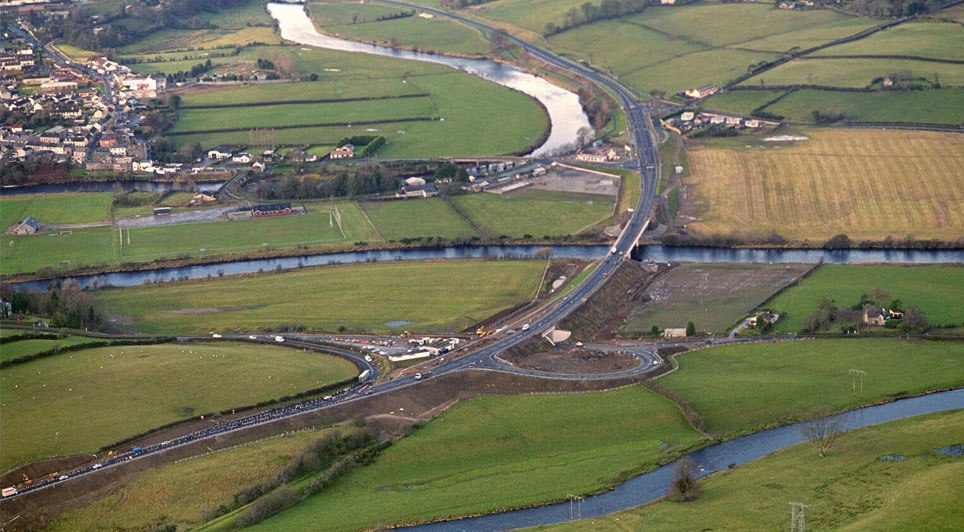
The Court of Appeal in Belfast has set aside a High Court judgment that had previously blocked the first phase of the proposed A5 Western Transport Corridor dual carriageway from moving forward.
Delivering its judgment on Tuesday, the Court of Appeal allowed the appeal brought by the Department for Infrastructure (DfI). The decision restores the Department's original authorisation to proceed with the initial stage of the major infrastructure scheme.
The overall A5 Western Transport Corridor project involves upgrading the current A5 route connecting Derry and Aughnacloy, stretching approximately 85 kilometres to form a continuous new dual carriageway. The first phase, authorised by the Department in 2024, spans roughly 55 kilometres between south of Strabane and Ballygawley, while also incorporating the westward extension of the existing A4 dual carriageway.
In reaching its verdict, the Court of Appeal examined four substantive grounds: compliance with environmental impact assessment requirements, human rights considerations, compliance with the Climate Change Act (Northern Ireland) 2022, and the evidence evaluated regarding climate change following the original High Court referral.
On the issue of environmental impact assessments, the court ruled that the High Court had erred in deciding that further consultation was required regarding greenhouse gas emissions linked to induced cross-border journeys. The judges held that the environmental statement was not deficient, relevant emissions had been assessed prior to the decision, and the Planning Appeals Commission had requested additional statistics rather than further public consultation.

The court also dismissed a human rights challenge concerning the impact of the scheme on affected landowners. In examining compulsory land acquisition, project uncertainty, and the Department's choice not to attach a time limit to its authorisation, the court determined that human rights implications had been properly considered. Furthermore, the Department had provided adequate reasoning for rejecting a Planning Appeals Commission recommendation that the scheme's approval should lapse if construction failed to begin by the end of the 2028/29 financial year.
The principal aspect of the appeal centred on Northern Ireland's climate legislation. Under Section 52 of the Climate Change Act (Northern Ireland) 2022, Northern Ireland departments must, so far as possible, exercise their functions consistently with statutory emissions targets and carbon budgets. The Court of Appeal clarified that this duty does not prohibit the approval of new road projects that increase emissions, provided the scheme has been evaluated for consistency with statutory climate duties so far as possible.
Additionally, the bench ruled that individual project approval is not dependent on the scheme being specifically detailed within a Climate Action Plan beforehand. The judges concluded that DfI held sufficient data regarding potential emissions and available transport-sector policy options to evaluate whether the road would breach statutory targets, confirming the Department exercised its duties lawfully under the 2022 Act.
Allowing the appeal on all four grounds, the court determined that the High Court was wrong to find an evidential gap rendering the decision irrational, confirming there was no failure to undertake necessary inquiries. The judges emphasised that the court's role is strictly to assess the lawfulness of the decision-making process, not to judge the merits of the road scheme itself.
The judgment removes the legal barrier established by the High Court decision of June 2025, leaving DfI's 2024 approval for phase one fully intact.
The broader A5 upgrade has been in development for nearly two decades, encountering multiple statutory processes and legal challenges. Supported by both the Northern Ireland Executive and the Irish Government, the project has been promoted to enhance regional connectivity and improve road safety. DfI noted in 2024 that 57 fatalities occurred on the A5 route between April 2006 and April 2024.
While the Court of Appeal ruling does not act as a direct order to begin construction work, it reinstates the Department's legal decision to proceed. The full written judgment will be published by the Judiciary of Northern Ireland.