Ireland
 UK
 Scotland
 London


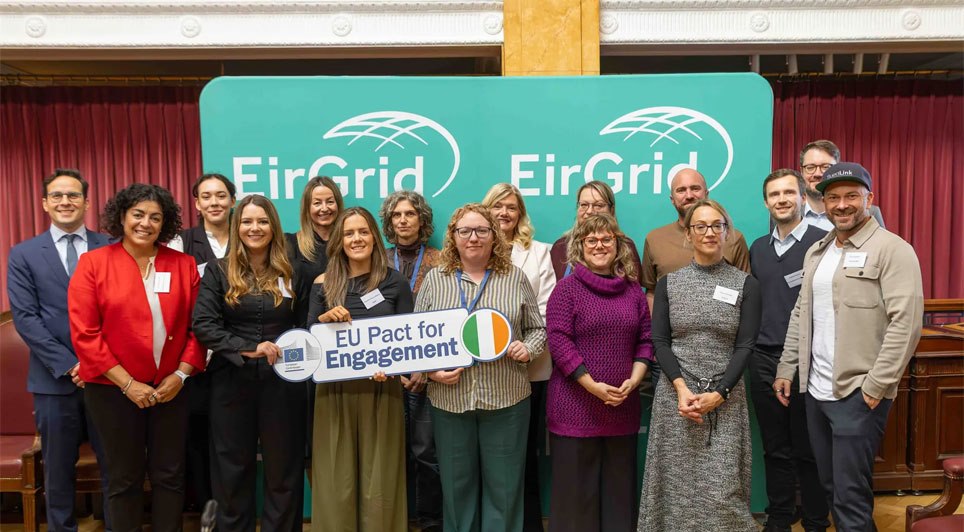
EirGrid gathered public engagement leads and energy sector stakeholders from across the continent at Cork City Hall for the latest session of the EU Pact for Engagement, a European Commission initiative aimed at deepening public participation in the rollout of energy infrastructure.
Running alongside the European Commission's 20th Strategic Energy Technology Plan Conference, co-hosted with Ireland's Department of Climate, Energy and the Environment, the programme convened representatives from transmission and distribution system operators, industry, NGOs and other groups to exchange experience and highlight effective approaches to community and stakeholder engagement.
Launched in 2023 under the European Commission's Action Plan for Grids, the EU Pact for Engagement is guided by ten principles designed to promote early, meaningful and inclusive dialogue with communities on energy projects. The initiative is co-chaired by the Commission's Directorate-General for Energy and EirGrid.

The Commission has recognised EirGrid's engagement methods on grid connection projects as examples of good practice aligned with the Pact's principles. These include its six-step grid development process, community forums, advisory councils, community benefit measures, and research collaborations such as with MaREI at University College Cork.
Sinéad Dooley, Head of Public Engagement at EirGrid and Co-Chair of the EU Pact for Engagement, said, "As Europe continues to invest in the electricity infrastructure needed to support the energy transition, meaningful engagement with communities has never been more important.
"It was a privilege to welcome colleagues from across Europe to Cork to share experiences and learn from one another. Open, transparent and accountable engagement helps build understanding and trust, leading to better outcomes for communities, infrastructure projects and the shift to a more renewable energy system."
Christopher Göpfert, Public Engagement Specialist at TransnetBW, Germany, said, "The challenges and opportunities we face in developing Europe's energy infrastructure are shared across borders. Since the Pact was established, participants have worked together to advance a number of the ten guiding principles outlined, sharing practical experience and developing a stronger common understanding of effective public engagement. This work will continue in the years ahead as we focus on the remaining principles, helping to strengthen public participation and build greater trust in the infrastructure projects that will support Europe's energy future."
Attendees also toured the Celtic Interconnector converter station at Ballyadam, gaining first-hand insight into one of Europe's most significant energy infrastructure projects and discussing how engagement practices are applied on the ground.